








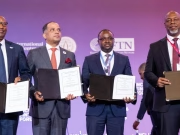






The Nigeria digital economy research landscape received a major boost with a $9 million (₦12 billion) national initiative launched in Abuja. It is designed to strengthen evidence-based policymaking, accelerate knowledge production, and anchor the country’s transition to a self-sustaining, innovation-driven digital economy.
Nigeria has officially launched the National Digital Economy Research Clusters Initiative, a $9 million (₦12 billion) strategic programme aimed at embedding rigorous, locally grounded research into the heart of the country’s digital transformation agenda.
The initiative is a joint effort between the Federal Ministry of Communications, Innovation and Digital Economy and the Federal Ministry of Education, funded under Project BRIDGE. It marks a deliberate pivot toward integrating academia, innovation ecosystems, and human capital development into national digital policy frameworks.
At its core, the Nigeria digital economy research initiative mobilizes universities and research institutions across six priority areas:
- Connectivity and meaningful access
- Digital public infrastructure
- Digital skills and human capital development
- Jobs and the digital economy
- Trust, safety, and digital governance
- Artificial intelligence and emerging technologies
These clusters are designed to generate policy-relevant insights while fostering stronger collaboration between government, academia, and the private sector—ensuring research outputs directly inform national strategy.
Speaking at the Abuja launch, Minister of Communications, Innovation and Digital Economy, Bosun Tijani, emphasized that sustainable digital growth requires homegrown intelligence.
“From the outset, we recognised a simple truth: the digital economy is a knowledge-driven sector. We cannot rely only on ideas developed elsewhere, so we must generate our own insights, rooted in our realities,” Tijani stated.
He positioned the initiative as critical infrastructure—not just physical broadband, but intellectual capital—to build a self-reinforcing digital ecosystem.
Nigeria’s digital economy currently contributes nearly 20% to GDP, up from 16–18% in prior years, with officials projecting growth to 21% in the near term. The new research clusters aim to accelerate this trajectory by aligning infrastructure investment with locally generated evidence and talent pipelines.
Tijani highlighted early wins from targeted AI research investments, including over 27 peer-reviewed publications and an improved global ranking in Artificial Intelligence readiness—proof, he noted, that strategic research funding yields tangible returns.
Education Minister Dr. Tunji Alausa reinforced the call for academic institutions to evolve beyond traditional pedagogy.
“Our universities must go beyond teaching and become engines of problem-solving, where real national challenges are studied and solved with rigour,” Alausa said.
He added that the initiative will support advanced researcher development—including PhD and postdoctoral fellowships—strengthening Nigeria’s pipeline of high-calibre policy analysts, data scientists, and innovation leaders.
By anchoring policy decisions in locally produced evidence, the Nigeria digital economy research initiative seeks to reduce dependency on external frameworks, enhance regulatory agility, and position Nigerian institutions as regional hubs for digital innovation.
As Africa’s largest economy navigates rapid technological change, this investment signals a commitment to building not just digital infrastructure—but the intellectual infrastructure required to sustain it.
Follow us on Instagram.
https://www.instagram.com/businessnewsng?igsh=ZXpweTdjOGF1ZXdu