














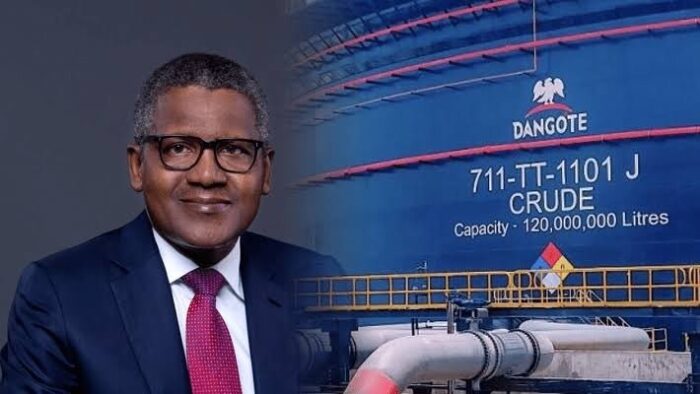
The Dangote Petroleum Refinery has slashed its Premium Motor Spirit (PMS) gantry price to ₦699 per litre, triggering an immediate ripple effect across Nigeria’s downstream fuel market. The new rate—among the lowest in recent history—has forced private depot owners in Lagos to cut their average selling price from ₦828 to ₦710 per litre in a bid to remain competitive. This Dangote Refinery petrol price drop 2025 marks a pivotal moment in Nigeria’s energy economy, showcasing the growing influence of domestic refining on national pump pricing.
Previously, fuel prices at retail stations were heavily influenced by import costs, foreign exchange rates, and logistics bottlenecks—all of which contributed to volatility and high consumer prices. But with the Dangote Refinery now operating at over 70% capacity, producing more than 400,000 barrels per day, it has become a dominant force in the local supply chain, capable of setting benchmark prices that others must follow.
“The market has changed,” said a senior executive at a major fuel marketing company who spoke on condition of anonymity. “When Dangote lowers its gantry price, we have no choice but to respond. Their volume and consistency give them pricing power.”
This Dangote Refinery petrol price drop 2025 comes amid increased output and improved logistics coordination between the refinery’s Lekki terminal and distribution depots. With crude oil processed locally instead of imported as refined product, the cost structure is significantly lower—freeing up margins even at reduced prices.
The Nigerian Midstream and Downstream Petroleum Regulatory Authority (NMDPRA) confirmed the shift, noting in its weekly price monitoring report that for the first time, locally refined petrol accounts for over 60% of total PMS supply in Lagos and surrounding states.
Retailers across Apapa, Mile 12, and Ikorodu have already adjusted their pump prices, with some selling as low as ₦730–₦750 per litre, down from as high as ₦900 just two months ago.
Consumers welcomed the relief after years of soaring transport and energy costs. “I fill my tank twice a week for work,” said Tunde Adekunle, a rideshare driver in Surulere. “At ₦750 instead of ₦900, that’s over ₦3,000 saved monthly. It makes a real difference.”
However, challenges remain. Some smaller marketers warn that compressed margins could threaten sustainability, especially if global crude prices rise or pipeline vandalism disrupts supply. There are also concerns about equitable access outside Lagos, where distribution infrastructure is weaker.
Still, analysts see this as a turning point. “This isn’t just cheaper fuel,” said Dr. Kayode Odeleye, energy economist at the University of Ibadan. “It’s proof that local refining can stabilize the market and reduce inflationary pressure on transportation and goods.”
With the Warri and Port Harcourt refineries also ramping up operations, and plans underway for export-ready shipments via the Bonny terminal, Nigeria may soon transition from net importer to regional exporter.
And as the Dangote Refinery petrol price drop 2025 reshapes expectations, one message is clear:
The era of unchallenged fuel pricing is over.
Now, competition—and local production—are driving value.
Follow us on Instagram.
https://www.instagram.com/businessnewsng?igsh=ZXpweTdjOGF1ZXdu