












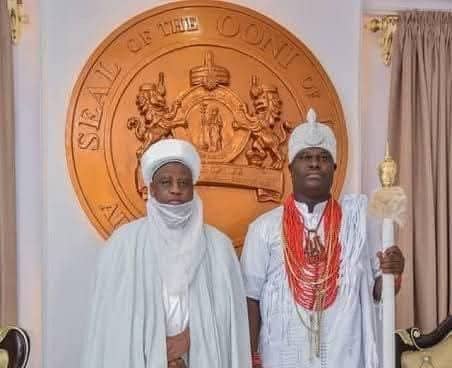
The pan-African sociocultural group, called ‘African Sociocultural Harmony and Enlightenment (ASHE) Foundation, has thrown its weight behind the proposed bill granting two revered monarchs, Ooni of Ife and Sultan of Sokoto as not only the approved captains of the Country’s sociocultural and traditional matters but also custodian of people’s faith in cultural heritage and related matters.
ASHE made this known in a statement to the media, signed by its leader, Prince Justice Faloye, following spats of furore emanating from the bill’s deliberation at the National Assembly. It stated that those who challenge the civilizational leadership of Ooni of Ife and Sultan of Sokoto, are still subservient to colonial psychocultural challenges, adding that the most strategic and enduring damage inflicted by colonialism on our collective psyche is our decivilization.
It explained that coloniality of knowledge sources wiped from our collective memory and identity, including the social organization level between tribalism and univeralism is known as civilizationism, adding that history and facts thoroughly define the roles of the two monarchs.
According to him, civilizationism is necessary for tribes to form strategic alliances to push collective aspirations, normally fostered with a collective narrative from common origins to collective aspirations. “There are four major world civilizations that include White Judeo-Christian; Islamic Afro-Asiatic; Buddhism Asian and Ifa-Afa-Iha-Efa indigenous African civilization,” stated ASHE.
Citing Chinua Achebe’s statement, he said that the colonialists cut the umbilical cord that tied us together as a civilization, so the center could no longer hold and things fell apart especially for indigenous Africans from Ife to Cape Town.
In addition to describing the cultural bonding pattern, ASHE stated that a person’s recognition of social organization starts from the mother that introduces the child to the father, through who the child knows the extended family based on common genetic orgins.
“Through the extended family, one knows the cultural values of the clan and township. From the township one learns the shared genetic origins and cultural values with other congruent towns in the region that give tribal identity. For a truly free people, the next social organization level is the shared genetic origins and cultural values between tribes that define their civilizations. Last, is the link between civilizations that make universalism, secular humanity. Without civilizational values, we adopt our colonialists global perspective, Westernization, as universalism.
“The Nigerian nation-state recognizes the fact that Nigeria, and Africa as a whole, is made up of two civilizations – indigenous African civilization based on the 16 sector African Information Retrieval System aka Ifa-Afa-Iha-Efa and the Afro-Arabic based on Islam, whose leadership was rightly identified as Ooni of Ife and Sultan of Sokoto. These conventions had been established for decades without any traditional ruler challenging the order, so it is audacious that the decivilized neocolonial political class that had wrestled power from the cultural custodians of ethnic nationalities, now have the effrontery to challenge the civilizational hierarchy that they had relegated to the background through Eurocentric neocolonial constitutions.
“The unifying of monarchs into powerful civilization blocs is not in the interest of the neocolonial ‘modernist’ political class that survive on prebendalist contracts and appointments, claiming spoils of democratic victory for family and cronies. Some have alleged that the President wants to employ the Council for his 2027 reelection, which is a feeble excuse because politicians have always used monarchs individually to get to the grassroots, and would be impossible to unite them all behind a single candidate.
“Moreso, the issue is not the formation of the traditional councils but challenging the civilizational leadership for tribal formations. Apart from genetic values from Harvard University and other prominent universities that show Yorubas have the oldest and most indigenous African DNA, and Fulanis have the highest percentage of Asiatic DNA, the cultural values are clear to the civilized. All Obi crowns in Igboland are tied to Oduduwa, which in Igbo language (Odu d uwa) means spiritual leader of the world. The Eze of Enugu stated in 2019 that if all Africans were Catholic, Ooni of Ife is the Pope. In addition to Edo crown tied to Oduduwa of the present Otu Ife, there are accounts by SK Owonaru (1949) that Ojo/Ujo the Ijaw progenitor was the first son of an earlier Oduduwa of Ife Ooyelagbo.
“All indigenous African groups social organization was based on the Oracle – the 16 sector Information Retrieval System aka Ifa-Afa-Iha-Efa, which is most complete and institutionalized in Ile-Ife, so even if the unchallengeable DNA evidence is put aside as Eurocentric, any traditional challenge will have to be in the recounting of the most Ifa-Afa-Iha-Efa verses known as Odu in Yoruba. Ooni of Ife leadership of the Indigenous African civilization is based on soft power of cultural relationships, not conquest like the Sultan of Sokoto.
“With regards to the Sultan of Sokoto leadership of the Islamic Afro-Asiatic civilization, he is the recognized leader of the Maliki school, one the five regional bodies of Islam globally, that is the Maliki (North and West Africa), Hanafi (Asia), Hanabali (Saudi), Shia (Iran) and Shafii (East Africa). Like with the Western European civilization that started with Greek followed by Romans and other European regimes up to USA, the Afro-Asiatic civilization in Africa has witnessed ethnic regime changes from Bornu-Kanem Empire from about 800AD, which took over indigenous African lands around Lake Chad, but was later subdued by the Kwararafa Confederacy, to the Fulani regime from 1800s that took more indigenous African lands and part of the Bornu Empire. Neither the Etsu of Nupe nor Shehu/Mai of Bornu would challenge the Sultan’s leadership instrumental in making Bornu NE region the largest with seven states and Etsu of Nupe Niger State the largest state.
“The lack of a civilizational identity not only robs a people of strategic alliances for greater demographic and political impact, it hinders political and economic development. Modern Development Economic theory postulates that ethnic diversity can inhibit economic development through prebendalism and political instability. Some development economists like Easterly and Levine first proposed an ethno-linguistic fractionalization index defined as FRAC or ELF, while Montalvo and Reynal-Querol recently put forward the Q polarization index as a more appropriate measure of ethnic division. Not only ethnic diversity but the comparative sizes of the ethnicities that might lead to hegemony and exclusionary politics as witnessed in Nigeria.
“Therefore a nation-state like Nigeria is better served by organizing its over 300 ethnicities into two manageable groups based on shared genetic origins and cultural values defined as civilizations. Specifically, the Sultan of Sokoto has been the defacto of the Northern territory in the colonial indirect rule, while other groups have been disparate and at a disadvantage. The only legitimate question can be whether a group like the Middlebelt rightly belongs to the Northern Afro-Asiatic or Southern indigenous civilization, but not their leadership.
“The problem is the continued effects of coloniality of knowledge and power sources, as well as other forms of coloniality. Following centuries of European weapons for slaves turning city-states into empires like Oyo, Benin, Igala etc that challenged existing civilizational arrangements, the British Colonists institutionalized our decivilization for effective colonization. To start, they committed epistemicide with their religion that was wrongly interpreted into dialects, to not only attack civilizational knowledge systems, but created tribes out of the continuum of dialects that spread from Nigeria to South Africa known as the Niger-Congo ethnolinguistic family.
“The Yoruba Bible was used to institutionalize the Oyo dialect as Standard Yoruba, while the Onitsha dialect was made the Igbo standard language. This was initially strongly rejected by other city-states and dialects conscripted into the new tribal formations up to the mid-1900s. Administratively, the British cut the upper limits of the Indigenous African civilization made up of hundreds of indigenous African groups and added them to the Northern Islamic protectorate as the Middlebelt, then split the remaining part of the Indigenous African civilization that made the up the Southern Protectorate into Eastern and Western regions.
“The British extended and strengthened the grip of the Sultan of Sokoto and his Afro-Asiatic civilizational leadership over most of Nigeria, making the North extend below River Niger into Ekiti Yoruba land and Benue, and all the kings met under him in an indirect colonial rule arrangement. On the other hand, they divided the South to weaken the influence of Ooni of Ife, Oba Adesoji Aderemi who the British labelled the biggest pain in the backside of the British Empire, because of his support of the independence movement. So in practice since independence, the Sultan has been able to unify the Northern Afro-Asiatic peoples, while Ooni of Ife has been enfeebled to stop the divide and rule and ethnic animosity between Yorubas and Igbos, the two most populous and prosperous Indigenous African groups, and other indigenous African groups rivalry. At the inauguration of the Southern Nigerian Traditional Council, the Ooni of Ife rightly recognized it as a coming together of brother kings of the same civilization for the first time since independence.
“First and foremost, the traditional council has no business with partisan politics and should fight for their inclusion into the constitution as permanent stakeholders of their civilization and ethnic nationalities – the constitutionalization of traditional polities. There are suggestions that since monarchs were not only the cultural but also moral custodians of their people, only them can make INEC truly morally just and independent. As a class, they should serve the long term interests of their peoples economic prosperity by holding to account short term professional politicians and activists.
“Ultimately, politicians that have been largely decivilized and politically divisive should leave the civilizational heirarchy to the traditional rulers, who are the paramount cultural custodians of their ethnic nationalities and know their shared values with other ethnic nationalities, without resorting to Eurocentric models that have failed in governance since independence.”
Follow us on Instagram
https://www.instagram.com/businessnewsng?igsh=ZXpweTdjOGF1ZXdu