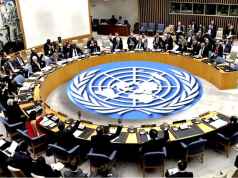















In a watershed moment for international diplomacy, the United Nations Security Council adopted Resolution 2724 demanding an immediate humanitarian ceasefire in Gaza, the unconditional release of all hostages, and full, rapid, safe, and unhindered humanitarian access throughout the enclave. The resolution passed with 14 votes in favor and one abstention—the United States—marking the first time since the conflict reignited in October 2023 that Washington refrained from using its veto power to block a ceasefire measure.
The text, drafted by Malta—the current non-permanent Council member representing Western Europe—and co-sponsored by ten nations including Japan, Switzerland, South Korea, and Sierra Leone, represents a rare consensus among global powers long divided over the war’s trajectory. It invokes Chapter VII of the UN Charter, giving it legal weight under international law, and calls on all parties to comply “without delay or condition.”
For over two years, repeated ceasefire resolutions had failed due to U.S. vetoes, reflecting Washington’s unwavering political and military support for Israel’s campaign against Hamas following the October 7, 2023 attacks. But today’s abstention signals a calibrated recalibration—one informed by mounting civilian casualties, deteriorating humanitarian conditions, and intensifying pressure from U.S. allies, civil society, and segments of Congress.
In a statement issued hours after the vote, U.S. Ambassador to the UN Linda Thomas-Greenfield emphasized that the abstention “does not reflect diminished support for Israel’s right to self-defense,” but rather acknowledges that “the scale of human suffering in Gaza has reached a point where silence is indefensible.” She added that the U.S. expects “all parties, including Hamas, to immediately release hostages and allow unimpeded aid.”
Israel reacted swiftly. The Ministry of Foreign Affairs condemned the resolution as “disconnected from operational realities on the ground,” arguing that a ceasefire would allow Hamas to regroup and rearm. “Terrorists do not negotiate in good faith,” read the official statement. “This resolution rewards brutality while ignoring the trauma of Israeli families still waiting for their loved ones.”
In contrast, Hamas’s political bureau in Doha welcomed the vote as “a victory for international conscience and the voiceless people of Gaza.” While stopping short of announcing specific compliance measures, the group called on “all nations to enforce this resolution without bias.”
On the ground, humanitarian agencies moved into action. The World Food Programme (WFP) confirmed it is assembling 120 aid trucks loaded with wheat flour, nutritional supplements, medical kits, and water purification units at the Egyptian side of the Rafah crossing. “We are coordinating final security clearances with Egyptian and Israeli authorities,” said WFP spokesperson Abeer Etefa in a press briefing. “Our goal is to reach northern Gaza within 48 hours—if access is granted.”
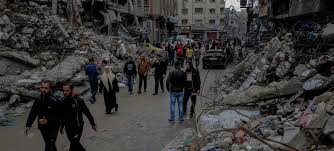
According to the UN Office for the Coordination of Humanitarian Affairs (OCHA), more than 85% of Gaza’s 2.3 million residents have been displaced, and famine-like conditions persist in the north, where aid deliveries have been sporadic since November 2025. Hospitals remain critically short of fuel, anesthesia, and antibiotics.
The passage of Resolution 2724 does not guarantee immediate de-escalation—enforcement mechanisms remain limited without unified great-power backing. Yet its symbolic and legal significance is undeniable. For the first time, the world’s most powerful security body has spoken with near-unanimity on Gaza, isolating Israel diplomatically even as its key ally steps back from absolute defense.
Analysts note that the abstention may also reflect internal U.S. political dynamics ahead of the 2026 midterms, where progressive lawmakers and Arab-American constituencies have intensified calls for conditioning military aid on humanitarian access.
As night falls over Gaza, families await not just food and medicine, but a tangible shift from words to protection. The resolution offers a framework—but only sustained pressure, accountability, and goodwill can turn it into peace.
Follow us on Instagram.
https://www.instagram.com/businessnewsng?igsh=ZXpweTdjOGF1ZXdu