










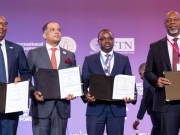





In a notable shift from years of cautious forecasting, PwC Nigeria has released its 2026 Economic Outlook with a tone of cautious optimism—centered on what the report describes as “emerging macroeconomic stability.” The analysis, published in early January 2026, projects Nigeria’s real GDP growth to reach 3.8% this year, up from an estimated 3.2% in 2025, marking a potential inflection point in the country’s economic recovery.
The PwC Nigeria 2026 Economic Outlook attributes this improved trajectory to three interlinked developments: the full unification of the foreign exchange market, a sustained decline in inflation, and stronger fiscal revenue performance following recent structural reforms. These factors, the report argues, have begun to restore a measure of predictability for businesses and investors after years of volatility.
According to the outlook, headline inflation—which peaked at 28.9% in January 2024—has shown consistent moderation, aided by tighter monetary policy from the Central Bank of Nigeria (CBN) and improved food supply chains. PwC now forecasts inflation to settle around 16.5% by the end of 2026, a level that, while still high, would represent significant progress toward price stability.
The naira’s stabilization since the completion of FX unification in 2023 has also narrowed the gap between official and parallel market rates—a key concern for importers and manufacturers. The report notes that this has reduced input cost uncertainty and revived activity in non-oil sectors, particularly agro-processing, fintech, and renewable energy.
On investment, the PwC Nigeria 2026 Economic Outlook cites early evidence of renewed confidence: foreign direct investment (FDI) inflows are estimated to have doubled year-on-year in the first half of 2025, reaching approximately $3.2 billion, according to data from the National Bureau of Statistics (NBS) and the Central Bank. While Nigeria still lags behind peers like Ghana and Kenya in per capita FDI, the trend reversal is notable.
Crucially, the report emphasizes that this optimism is conditional and fragile. “Stability does not equate to resilience,” the document cautions. Nigeria’s debt service-to-revenue ratio remains above 90%, severely constraining public investment in infrastructure, education, and healthcare. Power shortages, logistics bottlenecks, and security challenges in key agricultural regions continue to pose material risks.
The outlook also highlights that while revenue collection has improved—thanks in part to digital reforms like the Integrated Taxpayer Identification System (TIN) and enhanced customs enforcement—oil production remains below 1.5 million barrels per day, limiting fiscal buffers.
For the private sector, PwC recommends a “selective expansion” strategy in 2026, focusing on digital transformation, regional trade under the African Continental Free Trade Area (AfCFTA), and partnerships that leverage local content policies. The report identifies Lagos, Kano, and Port Harcourt as urban centers showing the strongest private-sector momentum.
Importantly, PwC’s analysis aligns with recent assessments from the World Bank and the International Monetary Fund (IMF), both of which have upgraded Nigeria’s near-term outlook—but with similar caveats about structural reform fatigue and political risk ahead of the 2027 electoral cycle.
The PwC Nigeria 2026 Economic Outlook stops short of declaring a boom. Instead, it frames the current moment as a window of opportunity—one that requires disciplined policy continuity, institutional strengthening, and private-sector engagement to convert stabilization into sustainable growth.
For business leaders, investors, and policymakers, the message is clear: the foundations are being laid, but the house is far from built.
Follow us on Instagram.
https://www.instagram.com/businessnewsng?igsh=ZXpweTdjOGF1ZXdu